 Skip to content
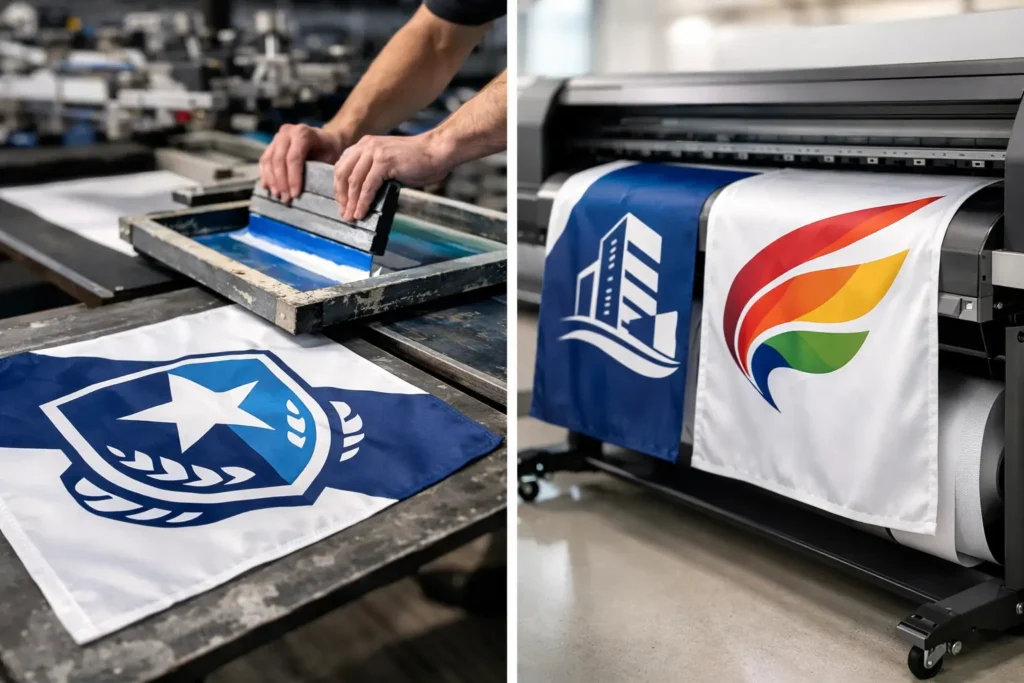
A flag that looks sharp in a proof can still disappoint once it is flying outside a dealership, across a golf course, or above a packed event tent. In the decision between screen printing versus dye sublimation, the right choice comes down to more than price. Your artwork, fabric, order size, viewing distance, and how the display will be used all matter.
Custom flags are our specialty, and there is no one printing method that fits every project. A simple two-color logo on a large run of promotional flags has different production needs than a full-color feather flag featuring photos, gradients, and sponsor logos. Knowing the difference helps you request the right product from the start.
Screen Printing Versus Dye Sublimation: The Core Difference
Screen printing applies ink to fabric through a mesh screen. Each ink color generally requires its own screen, and the printer builds the design color by color. It is a proven method for bold, simple graphics and can be a strong value on larger quantities when the artwork does not change.
Dye sublimation uses heat to transfer specially formulated dye into polyester fabric. Rather than sitting on top of the material, the dye becomes part of the fabric fibers. This process produces full-color artwork with fine detail, smooth gradients, and broad color variation without adding a separate screen for every color.
For many custom polyester flags and fabric banners, dye sublimation is the practical choice because it gives designers more freedom. That does not make screen printing obsolete. It simply means each method has a job to do.
When Screen Printing Makes Sense
Screen printing performs well when your design is clean, graphic, and built around a limited color palette. Think of a school mascot in two solid colors, a political slogan, a bold company wordmark, or a simple event message designed to be read from across a parking lot.
The finished design can have strong, solid areas of color. For large-volume orders with the same uncomplicated artwork, screen printing may offer favorable unit economics after the initial setup is absorbed across the run. That can be useful for campaigns distributing large quantities of stick flags, basic outdoor flags, or promotional pieces.
Screen Printing Has Setup Considerations
Every added color makes screen printing more involved. A design with four spot colors needs more preparation than a one-color print. A design with a photograph, a faded background, or dozens of shades is not a natural fit for this process.
Artwork changes also matter. If each location, sponsor, or team needs a different version of the design, screens may need to be remade. For that reason, screen printing is usually less flexible for variable designs and smaller orders with complex artwork.
Screen printing can also be a smart conversation when a particular fabric or production specification calls for it. The best approach is to share the intended use, quantity, and artwork early so the production team can recommend the method that fits the actual project instead of forcing the design into the wrong process.
Why Dye Sublimation Is Popular for Custom Flags
Dye sublimation is built for detailed branding. It handles logos with several colors, photo-quality images, shaded backgrounds, camouflage patterns, illustrated artwork, and small design elements far more naturally than a traditional screen-print process.
Because the dye is infused into polyester, the fabric stays soft and flexible. That matters for flags designed to move in the wind, including feather flags, teardrop flags, swooper flags, car flags, and golf pin flags. The print does not create a heavy surface layer that changes the feel of the fabric.
It also allows a design team to create a full visual field. Instead of limiting a banner to a few solid colors, you can use full-bleed color, edge-to-edge graphics, tonal backgrounds, and detailed sponsor recognition. For trade shows, fundraising events, sporting events, retail promotions, and outdoor activations, that flexibility can make a display look much more polished.
Full Color Does Not Mean Every File Will Print Perfectly
Dye sublimation gives you a wide color range, but the fabric, file quality, and final display size still affect results. Colors may appear differently on polyester than they do on a backlit computer monitor or a paper proof. Very small text can be hard to read when a flag is moving, and low-resolution artwork can look soft when enlarged.
A strong flag design uses adequate resolution, clear contrast, and type sized for real-world viewing. If a logo needs rebuilding or the artwork needs a cleaner layout, a full-time graphic design staff can help prepare it for production. That support is especially valuable when a customer has only an old logo file, a photo of existing artwork, or the beginning of an idea.
Print-Through and Two-Sided Designs
A key question for flags is what viewers will see on the reverse side. With standard single-reverse dye-sublimated flags, the image prints on one side and shows through to the back. The reverse image will appear mirrored, but the color is visible from both sides. This is a common and cost-effective construction for many outdoor flags.
If you need readable artwork in the correct direction on both sides, a true double-sided flag is the better option. It is typically made from two printed panels with a blocking layer between them. This adds material and production steps, but it prevents show-through and gives each side its own correctly oriented design.
Screen printing can also be used for certain two-sided projects, but the same practical questions apply: Does the message need to read correctly from both directions? Is there a different design on each side? Is the added investment worth it for the location? A flag mounted against a wall has different needs than a flag flying freely on a street corner.
Durability Depends on More Than the Printing Method
Buyers often ask which method lasts longer. The honest answer is that durability depends on the fabric, finishing, exposure, hardware, and care as much as the print method.
Dye-sublimated polyester is well suited to many outdoor display applications because the color becomes part of the fabric. Screen-printed products can also perform well when they are made with appropriate inks, material, and finishing. But neither process makes a flag immune to constant high wind, severe weather, abrasion against poles, or months of uninterrupted sun exposure.
For outdoor use, consider the full build: reinforced headers, grommets, pole sleeves, stitching, hemmed edges, and the appropriate fabric weight. A small car flag faces highway wind. A feather flag needs compatible hardware and a stable base. A canopy banner must be secured properly. Printing is one part of a commercial-grade display, not the entire durability story.
Cost, Quantity, and Turnaround
Screen printing can be attractive for large orders of the same simple design because its setup costs can be spread over many units. It becomes less attractive as the number of colors, revisions, or design versions rises.
Dye sublimation avoids per-color screen setup, so it is often more efficient for full-color designs, smaller custom runs, and artwork that changes from one version to another. A sponsor banner series, a set of team flags with individual names, or a regional campaign with location-specific details can be much easier to manage through digital production.
Turnaround should be discussed alongside print method, not after it. Quantity, fabric selection, finishing requirements, hardware, artwork readiness, and shipping destination all shape the production schedule. A quote-driven manufacturer can review the project details and identify the most realistic route before you commit to a deadline.
Choose the Method That Supports the Job
Choose screen printing when your design uses a few solid colors, your order is large, and consistency across a high-volume run matters more than photographic detail. It is a straightforward option for bold messaging and classic logo work.
Choose dye sublimation when your design needs full color, fine detail, gradients, photos, or frequent variations. It is especially well suited to custom feather flags, fabric banners, podium banners, club banners, car flags, and event displays where visual impact is doing the heavy lifting.
If your artwork falls somewhere in between, do not guess. Send the logo, describe where the display will be used, and include your quantity and deadline. The right question is not which method is universally better. It is which one will make your brand look clear, confident, and built for the way people will actually see it.
A custom flag has only a few seconds to get noticed. Start with the message you want people to remember, then let the fabric, construction, and printing method do their part.