 Skip to content
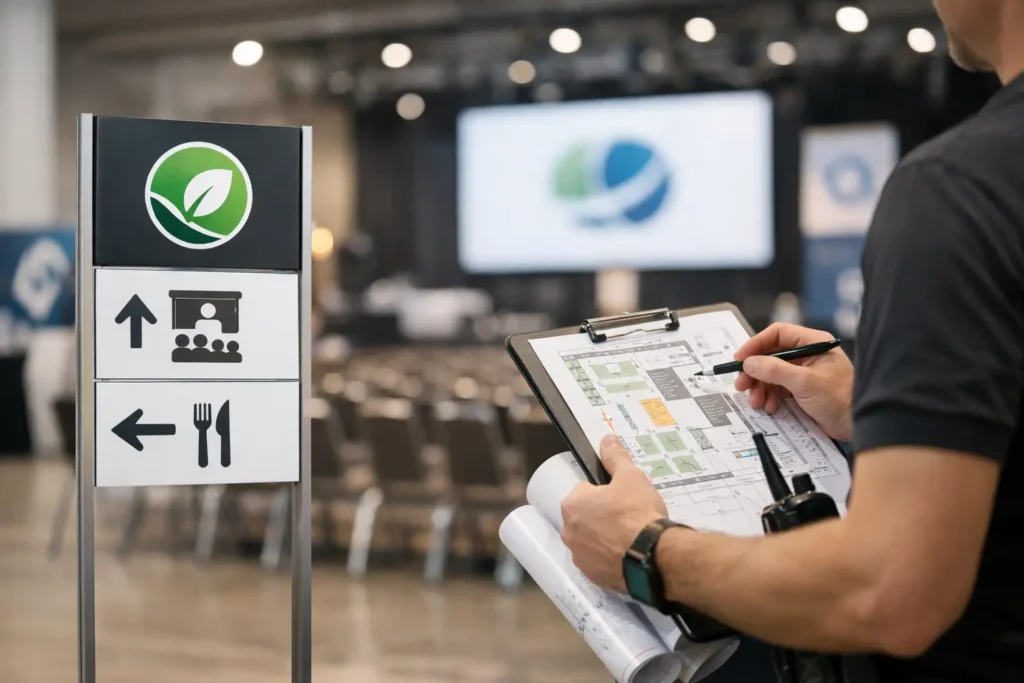
A crowded entrance is where good event branding gets tested. Guests are looking for parking, registration, a sponsor booth, or the right field, often while moving quickly. If your message is too small, placed too late, or hidden behind a crowd, even a great logo will not do its job. This event signage planning guide helps you map out displays that get noticed, guide people confidently, and give your organization a polished presence.
Start With What People Need to See
Event signage is not one job. A sponsor banner, a directional sign, a registration table cover, and a tall feather flag all serve different purposes. Start your plan by separating the information attendees need into three categories: arrival, navigation, and engagement.
Arrival signage helps people recognize they have reached the right place. This includes outdoor flags near roads or parking areas, entrance banners, and branded canopy tents. Navigation signage directs them once they are on site, from check-in and restrooms to activity zones, seating sections, or tee boxes. Engagement displays make the brand memorable after guests arrive, such as photo backdrops, sponsor banners, podium banners, and branded tables.
Write down the exact action each sign should prompt. “Turn here for parking” needs large, simple wording and a location with clear sightlines. “Thank you to our sponsors” can carry more visual detail because people will read it at a slower pace. When every item has a defined job, you avoid ordering displays that look good but leave guests guessing.
Walk the Event Like a First-Time Guest
The best planning happens before artwork is approved. Visit the venue, or study a detailed site map, and trace the path a first-time attendee will take from the street to the main activity area. Mark every decision point: driveway turns, parking entrances, building doors, registration lines, booth rows, and exits.
At each point, ask two questions: What does someone need to know here, and how much time do they have to see it? A driver may only have a few seconds to spot a parking entrance. A tall feather flag or swooper flag can create visibility from a distance, while a horizontal banner may be more useful at the actual turn. Inside a ballroom, a podium banner or fabric banner can help define the stage without competing with speakers or projection screens.
Also account for obstructions. Parked vehicles, vendor tents, trees, doors, people in line, and temporary fencing can block a display that looked perfect on a floor plan. Outdoor signs should be elevated when possible, and key messages should appear more than once along a busy route. Repetition is not wasted space when it prevents confusion.
Build a Simple Signage Map
A signage map does not need to be complicated. Use the event layout and label each display by its purpose, location, size, and deadline. Include who is responsible for installation and removal. This is especially valuable for fundraisers, tournaments, school events, trade shows, and multi-day activations where volunteers or venue staff may change shifts.
Your map should show which items must be visible from a distance and which are meant for close viewing. It should also note power restrictions, tent locations, wind exposure, venue rules, and whether signs need bases, poles, stakes, or hanging hardware. A beautiful custom banner cannot help if there is no approved place to hang it.
Choose the Right Format for the Location
The right display format depends on viewing distance, weather, traffic flow, and the message itself. One banner style is rarely the answer for an entire event.
Feather flags, teardrop flags, and swooper flags are strong choices for outdoor arrival zones, entrances, dealership promotions, sports fields, and retail events. Their height and movement help them stand out in open areas. Teardrop shapes hold their form well in changing conditions, while feather flags offer a larger vertical area for a logo, short message, or directional cue.
Custom outdoor flags work well when you need a classic, high-profile branded presence. They are a natural fit for community events, political gatherings, golf outings, school campuses, and sponsor recognition. For vehicle-based promotions, car flags, antenna flags, and car mirror socks extend visibility beyond the event footprint.
Fabric banners are versatile for fences, booths, stages, walls, and indoor displays. A large banner can establish the event identity at the entrance, while smaller versions can identify stations or sponsor areas. At a registration table, a branded table cover turns a practical surface into a highly visible part of the welcome experience. Pair it with a canopy pop-up tent for outdoor check-in, sampling, merchandise, or fundraising stations.
There are trade-offs. Tall flags attract attention but are not ideal for paragraphs of information. Table covers look professional at close range but do little for people across a parking lot. A large banner can carry detailed sponsor logos, but only if attendees have time and space to read it. Match the format to how people will actually encounter it.
Keep the Message Short and the Hierarchy Clear
A display has one main job. Treat the largest element as the answer to the most immediate question. For an entrance flag, that may be the event name or a simple “Welcome.” For a directional banner, it is the destination and an arrow. For a sponsor display, it may be the presenting sponsor’s logo.
Do not try to fit the event schedule, every social handle, a full mission statement, and six sponsor tiers onto one sign. People do not read signage the way they read a brochure. They scan color, shape, large type, and familiar logos first.
Use high contrast between the background and lettering. Dark type on a light background or light type on a dark background is generally easier to read than colors with similar values. Give copy room to breathe, particularly on flags that may move in the wind. If a message must be read from across a field or parking lot, reduce it to the essentials.
Logo placement matters, too. Keep important marks away from hems, pole sleeves, grommets, folds, and the bottom edge of a table cover. On a feather or teardrop flag, design for the shape rather than forcing a rectangular flyer into a vertical format. A full-time design team can help rebuild a low-resolution logo, refine supplied artwork, or create a layout that fits the product correctly.
Plan for Weather, Wear, and Setup Time
Outdoor displays need more than good graphics. They need materials and hardware suited to the environment. Consider wind, sun, rain, uneven ground, and the length of the event. A one-day sidewalk promotion has different demands than a season of athletic events or a touring sponsorship program.
Ask how each display will be secured. Flags may require ground stakes, cross bases, weighted bases, or other solutions depending on the surface. Canopy tents need proper anchoring. Banners need appropriate mounting points and tension so they do not sag or flap into unreadability. Always follow venue requirements and local safety rules, especially near roads, walkways, and crowded entrances.
Setup deserves its own schedule. Install primary arrival and directional signage before guests begin arriving, then walk the route again at attendee eye level. Check whether arrows point the correct way, whether the registration area is visible, and whether sponsor logos face the intended traffic flow. Keep extra fasteners, weights, and a basic repair kit on hand. Small setup issues are common, and quick fixes protect the guest experience.
Order Early Enough to Get the Details Right
Custom signage works best when planning starts before the final week. Early ordering gives you time to confirm quantities, choose sizes and fabrics, review artwork, and solve venue-specific installation questions. It also lets you coordinate colors and design elements across flags, banners, tents, and table covers instead of creating each item separately.
For recurring events, think beyond one date. Reusable branded flags and tents can support annual fundraisers, seasonal promotions, trade show calendars, and multiple community appearances. Event-specific banners may need a date or theme, but core logo displays can stay useful long after the program ends. That balance helps stretch your display budget without making the event look generic.
If you have finished print-ready art, send it with clear placement notes. If you only have a logo, a rough concept, or an old file that needs work, say so early. Flags Made can provide direct design support and quote-driven custom production for organizations that need the right sizes, shapes, fabrics, and finishing details for their event plan.
Before event day, hand your signage map to the person leading setup and make sure they understand the order of installation. A clear route, a readable message, and a few well-placed branded displays can make guests feel expected from the moment they arrive.