 Skip to content
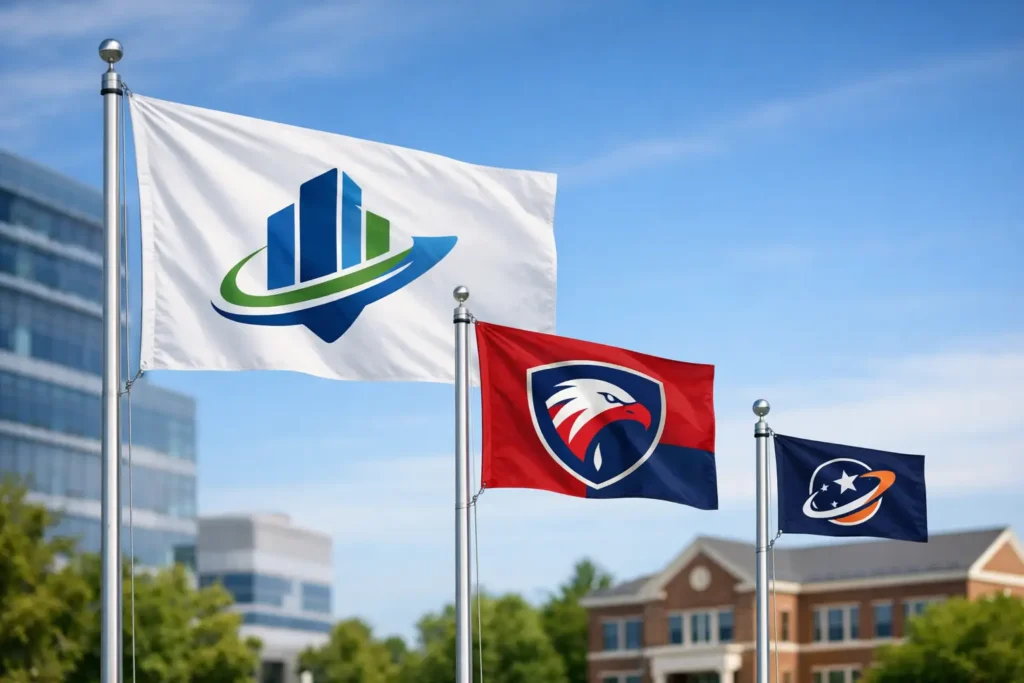
A flag that is too small disappears before it can do its job. A flag that is too large can overwhelm a booth, drag on the ground, strain a pole, or make a logo hard to read. If you are asking what flag size to order, start with where people will see it, how far away they will stand, and what needs to fit on the design.
Custom flags are our specialty, and size is not a one-number decision. The right choice for a school fundraiser is different from the right choice for a dealership lot, golf tournament, parade vehicle, trade show booth, or corporate building. A well-sized flag gives your message room to be seen and helps your display look intentional from every angle.
What Flag Size Should You Choose?
Choose flag size based on viewing distance, mounting method, available space, and the amount of artwork you need to show. A compact flag works well when viewers are close. A larger flag earns its place when it must compete with traffic, open outdoor space, or a busy event environment.
For most custom flag projects, the question is not simply, “What is the biggest size available?” It is, “What size makes our logo, message, and event presence easy to notice?” That distinction saves money and produces a better result.
A simple rule helps: the farther away your audience is, the larger and cleaner the display should be. If people will be standing 5 to 10 feet away at a registration table, a small stick flag or tabletop display can work beautifully. If drivers need to notice a promotion from across a parking lot, a standard outdoor flag or tall feather flag is the stronger choice.
Start with the viewing distance
Think about the first moment someone needs to recognize your flag. At a booth, that may be from the next aisle over. At a street-side promotion, it may be from a passing car. At a sports field, it may be from the stands.
Small hand flags are ideal for close-range visibility, handouts, table arrangements, parade groups, and vehicle windows. Medium flags suit entrances, tents, storefronts, sponsor displays, and community events. Large flags are built for broad outdoor visibility, tall poles, open grounds, and locations where your message needs to stand above the crowd.
Distance also affects the artwork. A 3-by-5-foot flag can carry a logo, short headline, and simple graphic elements. A small flag may need a logo and little else. Trying to fit a full schedule, several sponsor logos, a phone number, and a detailed illustration onto a small flag usually creates clutter rather than impact.
Match the flag to its display location
The place you install the flag sets real limits. Measure the area before you settle on dimensions. Check for walls, awnings, landscaping, power lines, nearby signs, tent frames, and foot traffic. Outdoors, allow enough clearance so the flag can move naturally without hitting the ground or nearby objects.
For a building-mounted or ground-set flagpole, the flag should look proportional to the pole height. A common starting point is a flag length around one-quarter of the pole height. For example, a 20-foot pole often pairs well with a flag around 3 by 5 feet or 4 by 6 feet, depending on the setting and local conditions. Larger flags create stronger visibility, but they also place more stress on the pole and hardware in windy conditions.
For a trade show, retail counter, or podium, oversized is rarely the answer. Space is tight, people are close, and the goal is polished brand presence. Stick flags, tabletop flags, podium banners, and compact fabric banners can deliver plenty of color without blocking conversations or product displays.
Common Custom Flag Sizes and Their Best Uses
There is no single standard for every custom flag shape, but a few familiar sizes give buyers a practical place to begin.
A 12″x18″ or 18″x24″ flag is a smart choice for stick flags, small displays, vehicle use, group celebrations, and close-up promotions. These sizes are portable, affordable in quantity, and easy to distribute at parades, campaign events, school spirit days, and nonprofit fundraisers.
A 2’x3′ flag is a useful step up for smaller exterior poles, tents, booth walls, and building entrances where viewers are nearby. It provides more room for branding while staying manageable in compact spaces.
A 3’x5′ flag is one of the most versatile choices for outdoor promotions. It is substantial enough for storefronts, clubs, schools, sports organizations, dealerships, and event grounds, yet it remains practical for many standard flagpole setups. If your design includes a recognizable logo and a concise message, this size often gives both elements the breathing room they need.
A 4’x6′ flag or 5’x8′ flag makes a stronger statement for larger poles, open properties, special events, and highly visible locations. These sizes work best when the hardware, wind conditions, and installation space can support them. They are not automatically better for every project, but they are hard to miss when used in the right setting.
Tall specialty flags follow a different sizing logic. Feather flags, teardrop flags, and swooper flags are measured largely by their overall height and shape rather than a standard rectangle. A 7 to 9 foot display may work near a storefront entrance or tent. A 12 to 15 foot version is better suited to roadside promotions, parking lots, festivals, and large outdoor activations. Their vertical format makes them especially effective where ground-level signs would be hidden by people, vehicles, or vendor tents.
Choose size with wind and durability in mind
A larger flag catches more wind. That is part of its visual appeal, but it also means the fabric, stitching, pole, and mounting hardware need to be chosen for the environment. A flag that performs well on a calm indoor display may not be appropriate for a permanently exposed outdoor pole.
For long-term outdoor use, discuss the intended location and typical weather before production. Strong wind areas may call for a more conservative size, reinforced finishing, or a pole system designed for the load. Seasonal promotions can often use a bolder size because the display is only installed for a limited run. The best option depends on the project, not just the artwork.
Fabric matters, too. Lightweight polyester can create excellent movement and color for many promotional flags. Heavier materials may be preferred for particular uses, finishes, or display conditions. Your fabric choice should support the size and purpose of the flag instead of being treated as a separate decision.
Make the Design Fit the Flag Size
The more information you put on a flag, the more size you need. That does not mean every large flag should be packed with text. It means the design should use available space wisely.
A strong custom flag usually leads with one visual priority: a logo, team mascot, event name, sale message, or bold graphic. Add secondary information only if it remains readable from the intended distance. Large type, high color contrast, and simple shapes travel farther than fine print and intricate details.
This is especially true for double-sided flags. Depending on the printing method and fabric, artwork may show through from the reverse side or be built as separate panels for a more finished two-sided presentation. A design team can help prepare the artwork correctly so type reads the right way and your brand colors perform well on fabric.
If you already have artwork, provide the highest-quality logo file available. If you only have a low-resolution image, an old business card, or an idea sketched on paper, that is still a workable starting point. A full-time design staff can rebuild a logo, clean up artwork, and create a flag layout that fits the final dimensions instead of forcing your design into the wrong format.
Do not forget the pole and finishing details
Flag size and finishing go together. A sleeve, grommets, rope and thimble, header, or other attachment method changes how the flag hangs and where the artwork should sit. A pole sleeve takes up space along one edge, for example, so keep critical text and logo details clear of that area.
For car flags, antenna flags, and mirror socks, the vehicle itself sets the scale. Compact, high-contrast artwork is more effective than a crowded design. For golf pin flags, consider the viewing angle from the tee and green, along with the need for sponsor identification. For indoor flags, prioritize proportion, presentation, and a finish that looks right in photographs and formal settings.
Before ordering, share the flag’s use, location, mounting plan, desired quantity, and target delivery date. Those details help the manufacturer recommend a size that works in real life, not just on a screen.
The best flag size is the one that makes your message visible, fits its surroundings, and holds up to the job. When you are ready to turn a logo or idea into a display people will notice, a quick conversation with the Flag Makers can turn “what flag size?” into a confident, custom-built answer.