 Skip to content
A parked service van, dealership lot, parade vehicle, or event shuttle can do more than get people from place to place. It can put your name in front of local customers all day. This mobile advertising flag guide helps you choose a flag setup that is easy to spot, fits your vehicle or event plan, and represents your organization clearly.
Mobile flags work because they add movement, color, and height to places where standard signs can disappear. The right product depends on where it will be used, how fast it will move, how long it will stay outdoors, and what you need viewers to remember in a few seconds.
Start With the Job Your Flag Needs to Do
Not every advertising flag is meant for the same setting. A custom car flag is a strong choice for parades, dealership promotions, community events, campaign visibility, and local business vehicles. It mounts to a vehicle window and gives your message presence without covering the doors or windows with a permanent wrap.
Antenna flags are smaller and more compact. They work well for fleets, golf carts, motorcycles, dealership inventory, and promotional vehicles where you want a recognizable logo or short message without a large display. Their smaller size makes them especially useful when you have many vehicles to brand at once.
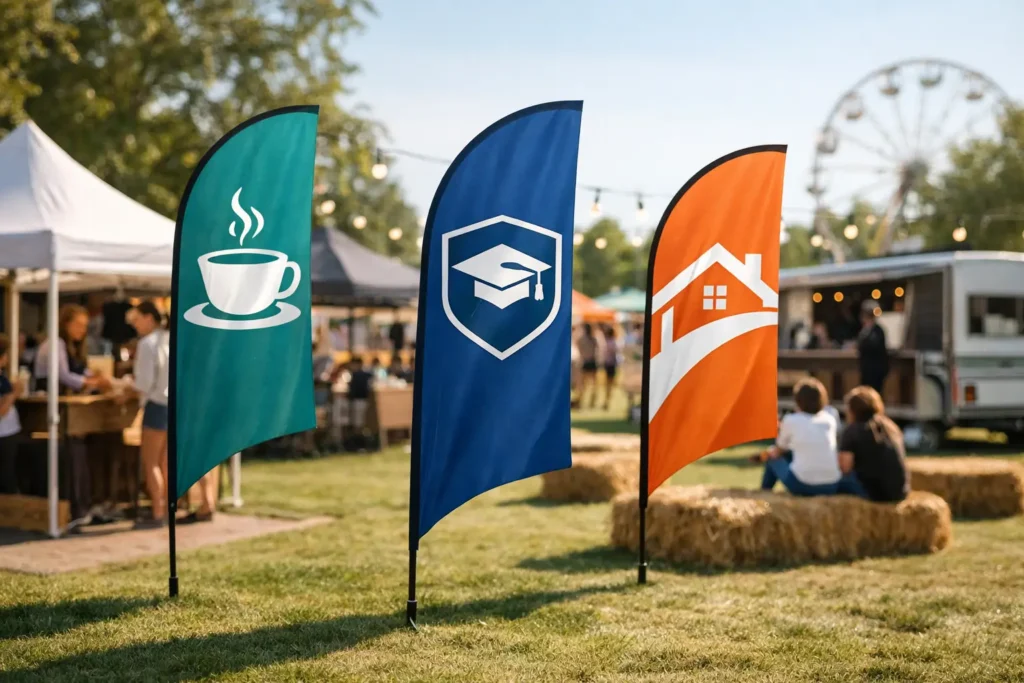
For a vehicle that will be parked at an event, feather flags, teardrop flags, and swooper flags can create a bigger visual footprint around it. A food truck, sponsor tent, open house, race check-in, or fundraising booth may benefit more from tall ground-mounted flags than a vehicle-mounted option. The vehicle brings people to the location, while the flags help them find it.
The best choice is often a combination. A car flag can carry your brand through town, while feather flags mark your space once you arrive. If your promotion has several stops, matching flag styles and colors make the campaign feel organized rather than pieced together.
Choose a Mobile Advertising Flag Format
Car Flags for High-Visibility Local Promotion
Car flags are designed for visibility from the side of a moving or parked vehicle. They are popular with schools, sports teams, political campaigns, real estate professionals, auto dealers, nonprofits, and businesses sponsoring local events. A bold logo, team mark, election message, or event name reads quickly when the design is kept simple.
Use a car flag when the vehicle itself is part of the promotion. Think of a contractor visiting job sites, a dealership hosting a sale, or a club driving in a holiday parade. Keep in mind that car flags are most effective for short, high-impact messages. A web address may be useful, but a large logo and a few words will usually perform better than a full list of services.
Antenna Flags for Fleets and Smaller Vehicles
Antenna flags offer a lighter profile and can be a practical option for promotions involving several vehicles. They are a good fit for dealership rows, golf tournaments, delivery teams, car clubs, and branded event transportation. Because the print area is smaller, prioritize one visual focal point: your logo, mascot, campaign icon, or a short callout such as “Now Open.”
They are not the right choice when your goal is to communicate detailed information from across a parking lot. For that, use them as a recognizable brand marker and support the message with larger flags or banners at the destination.
Feather, Teardrop, and Swooper Flags for Stops
Tall flags earn their place when your promotion is stationary. Feather flags provide a long, vertical print area that works well for logos, directional messaging, and retail promotions. Teardrop flags have a taut, rounded shape that stays readable in lighter wind conditions. Swooper flags bring a high-energy look that suits grand openings, weekend sales, sports events, and roadside promotions.
Your base matters as much as the flag shape. A ground stake is useful for grass and soil. A cross base or weighted base is better for pavement, indoor floors, and other hard surfaces. If your event setup moves from one location to another, select hardware that your team can transport, assemble, and secure without slowing down the day.
Design for a Three-Second Look
People often see mobile advertising while walking, driving, or scanning a busy event area. Your design should make its point before the flag moves out of view. Start with the element that must be remembered: a business name, logo, school initials, campaign name, or event date.
Use high-contrast colors. Dark lettering on a dark field may look polished on a computer screen but can disappear outdoors. White, yellow, or bright colors can stand out against darker backgrounds, while black or navy graphics can read well on light-colored fabric. Your exact palette should still match your brand, but visibility has to lead the decision.
Avoid shrinking too much copy onto the flag. A full mission statement, multiple phone numbers, social handles, and a detailed service list compete for attention. For mobile use, one logo plus one short message is often enough. If a phone number or website is essential, make it large enough to be useful when the vehicle is parked.
Use readable typefaces with clear letter shapes. Script fonts and thin lettering can lose clarity when fabric moves in the wind. Strong sans-serif lettering, simple bold type, and clean spacing tend to hold up better at a distance.
Match Fabric and Printing to Real Conditions
Your mobile flag needs to handle the conditions it will face, not just look good in a product photo. Outdoor use calls for materials and printing selected for wind, sun, travel, and repeat handling. The size of the flag and the strength of the mounting hardware should be appropriate for the intended vehicle and use case.
Single-sided printing can be a cost-effective choice for many designs, especially when the artwork is simple and the flag will be viewed mainly from one direction. Double-sided options may be worth considering when readability on both sides is a priority. The trade-off is usually cost and construction, so discuss how and where the flag will be seen before deciding.
For a one-day parade or annual tournament, a lighter promotional setup may be all you need. For a dealership, campaign, or business vehicle used week after week, it makes sense to prioritize durable fabric, dependable hardware, and artwork that can be reordered consistently when your fleet grows.
Plan Installation and Safety Before the Event
A great-looking flag is only useful if it is installed correctly. Follow the hardware instructions, confirm that mounts are secure, and check the flag before every use. Make sure it does not block the driver’s view, lights, mirrors, license plate, or access to doors and windows.
Consider the route and weather. Wind load changes quickly at road speeds, and a flag that works for a slow parade may not be suited to longer highway driving. Use vehicle-mounted flags according to their intended use, remove them when conditions are unsuitable, and follow local traffic rules, venue requirements, and fleet policies.
At a stationary activation, secure bases properly and give tall flags enough clearance from pedestrian paths, tents, power lines, and neighboring displays. A little site planning protects your display and keeps the event space welcoming.
Make Mobile Flags Part of a Bigger Display Plan
The strongest mobile campaign does not rely on a flag alone. It carries the same visual identity across the vehicle, booth, tent, table cover, banners, and handouts. When someone sees your car flag on Friday and your canopy at the Saturday event, the repeated colors and logo create recognition.
For a fundraiser, pair school or team car flags with custom stick flags for supporters and a larger banner at the entrance. For a dealership sale, use antenna flags on featured inventory and swooper flags near the road. For a golf event, use branded golf pin flags on the course and feather flags at registration. Each item has a different job, but the message stays consistent.
Custom Flags are our specialty at Flags Made. If you have polished artwork ready to print, a rough logo that needs cleanup, or only an idea for a mobile promotion, a full-time graphic design team can help shape it into a flag that works in the real world.
Before requesting a quote, have a few details ready: the flag style you are considering, approximate quantity, where it will be used, your deadline, and any available artwork. Those basics make it easier to recommend the right size, fabric, print method, and hardware.
A mobile flag should feel like a clear invitation, not a moving billboard packed with information. Choose one message worth seeing, give it room to stand out, and let your vehicles and event displays keep working long after the first introduction.