 Skip to content
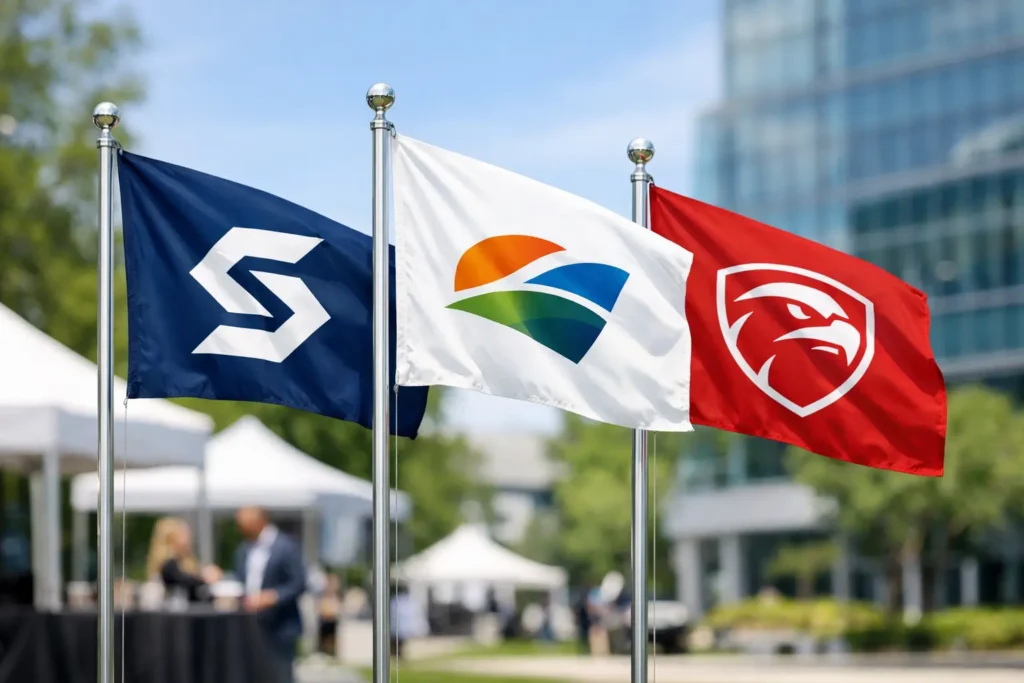
A flag that disappears into the background is a missed opportunity. Whether it is flying outside a dealership, marking a golf hole, lining a fundraiser route, or adding team spirit to the stands, the right custom flag puts your logo where people can see it. Knowing how to order logo flags starts with matching the flag to the place, the audience, and the way it will be used.
Custom Flags are our specialty, but a great result does not begin and end with uploading a logo. Size, shape, fabric, print style, hardware, and artwork all affect how your finished flag looks in motion and how well it holds up. Start with a clear purpose, then let the details support it.
Start With Where Your Flag Will Be Seen
Before choosing colors or dimensions, picture the flag in use. A flag mounted outside a business needs a different setup than one carried in a parade or displayed behind a registration table. The viewing distance matters too. A small hand-held stick flag can create energy at a community event, while a tall feather flag can pull attention from across a parking lot.
Outdoor flags are a strong fit for storefronts, schools, municipal buildings, clubs, and sponsor areas. They are built to fly from a pole and give your logo a traditional, established look. For trade shows, race days, retail promotions, and outdoor activations, feather flags, teardrop flags, and swooper flags bring height and movement without taking up much ground space.
For vehicle-based promotion, car flags, antenna flags, and car mirror socks turn traffic into visibility. Golf pin flags make sense for tournaments, country clubs, sponsor recognition, and charity outings. Indoor flags, podium banners, and club banners work especially well where a polished presentation matters as much as distance viewing.
The format should follow the job. A dramatic tall flag is not always the best choice if guests will be standing only a few feet away. Likewise, a compact flag may not do enough when your goal is to be noticed from the road.
How to Order Logo Flags With the Right Specifications
Once you know the application, you can make the choices that shape production. You do not need to have every answer before requesting a quote. A good custom flag manufacturer can help you narrow the options. Still, coming prepared with a few basics makes the process faster and keeps the design focused.
Choose a size for viewing distance
Think about where people will first see your message. Larger flags are easier to spot from farther away, but they need enough clear space to display well. Small flags are ideal for crowds, tables, vehicles, or close-up branding. If your logo includes a long business name, a wider flag shape may give it more room to breathe than a narrow vertical format.
Avoid trying to make one flag do every job. A retail promotion may need tall feather flags at the entrance and smaller branded table covers or stick flags at the checkout area. Using coordinated pieces often creates a stronger presence than relying on a single oversized display.
Select fabric based on use
Fabric is more than a production detail. It affects motion, opacity, weight, and durability. Outdoor applications generally call for materials selected to fly well and handle regular exposure. Indoor flags may allow for different priorities, such as a refined presentation or a specific display finish.
Tell the production team whether the flag will be used occasionally, displayed for a short campaign, or flown repeatedly. Also mention if it will be installed in an especially windy location. No fabric is immune to severe weather or years of constant exposure, but choosing for the real conditions helps set the right expectations.
Decide on one-sided or two-sided printing
This choice is easy to overlook until the flag is in the air. A single-reverse flag is printed on one side, with the design visible in reverse on the back. It is a popular option for many outdoor flags because it is lightweight and allows the fabric to move naturally.
A double-sided flag is designed so the artwork reads correctly from both sides. It is often the better choice when your logo, lettering, or message must be easy to read from either direction. Because construction and materials differ, double-sided flags can carry a different cost and weight. If readability is the priority, say so early in the quoting process.
Pick finishing and hardware that fit the display
A finished flag needs a practical way to hang, mount, or carry it. Depending on the product, this may involve grommets, pole sleeves, header tape, clips, stakes, bases, or vehicle mounts. The correct finishing depends on the flag style and the hardware you plan to use.
If you already have poles or display stands, share their measurements and setup details before production begins. If you need a complete display, ask for the flag and hardware as a matched system. A beautiful custom print is only useful when it installs securely and looks right in its final location.
Prepare Artwork That Reads From a Distance
Your logo may look perfect on a website and still need adjustment for a flag. Fabric moves. Wind folds the surface. People may see the design while walking or driving by. The strongest flag artwork is bold, clean, and easy to recognize quickly.
Vector artwork is usually the best starting point because it can be scaled without losing sharpness. Common vector file types include AI, EPS, and PDF files created from original artwork. High-resolution PNG or JPG files can also work for some designs, especially when they are large and clear. A tiny image copied from social media is rarely the right file for a large custom flag.
Keep fine details in check. Small taglines, thin lines, complex gradients, and crowded photo elements can become hard to read on a moving fabric display. That does not mean your flag has to be plain. It means the primary logo, color blocks, short message, or key image should do the visual work.
Color deserves attention as well. If your organization uses specific brand colors, provide them with your artwork. A designer can help translate your look to the chosen fabric and printing method. For sponsors, schools, and sports teams, color consistency is often what makes a flag feel official rather than generic.
If you do not have print-ready art, do not let that stop the project. Flags Made has a full-time graphic design staff that can rebuild a logo, clean up an existing file, or create an original flag design from your initial idea. Send what you have, even if it is a rough sketch, an old image, or a photo of a previous flag.
Give Your Quote Request the Details That Matter
Custom production works best when the quote request includes enough information to guide the recommendation. You do not need a formal specification sheet, but the following details help the Flag Makers point you toward the right product:
- The flag type or the goal for the display
- Desired size, quantity, and deadline
- Indoor, outdoor, vehicle, golf, or event use
- Whether both sides must read correctly
- Your logo files, colors, wording, and any design direction
- Needed hardware, mounting method, or existing pole measurements
Be direct about your deadline. Events do not move because a flag shipment is late, and custom printing needs time for artwork approval and production. Ordering early gives you more flexibility if the design needs revisions or if you decide to add matching banners, tents, table covers, or pennants.
Quantity can also affect the best approach. A single commemorative flag and a large run for a regional campaign may use the same logo, but their budget, distribution, and finishing needs can be very different. Ask for a quote that reflects the actual purpose instead of choosing solely by the lowest unit price.
Review the Proof Before Production
The artwork proof is your moment to catch preventable mistakes. Review every word, phone number, website address, sponsor name, date, and logo placement. Confirm the flag orientation, the side that will be visible, and whether any back side is intended to be reversed or readable.
Look at the proof as your audience will. Can someone identify the organization from a distance? Is the main message large enough? Does the design still make sense if part of the flag folds in the wind? A proof may be technically accurate while still benefiting from a simpler layout or larger logo.
Have the person responsible for brand approval review it, especially for school districts, corporations, political organizations, and sponsored events. A short review now is much easier than discovering an outdated logo or misspelled sponsor name after the flags arrive.
A logo flag should do more than carry your mark. It should make your organization feel present wherever people gather, shop, compete, celebrate, or travel. Bring the idea, the logo, and the goal to the conversation, then get a quote from a team that makes custom flags every day.