 Skip to content

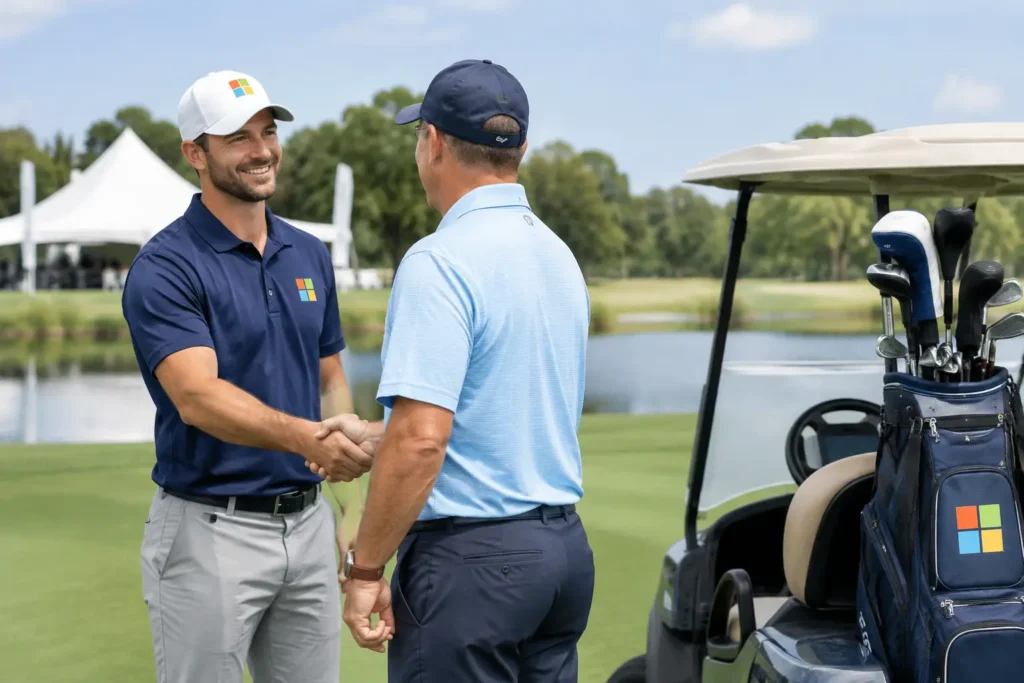
The first tee is not the only place a sponsor needs to be seen. Players notice a brand while checking in, warming up, finding the putting contest, grabbing lunch, and waiting for awards. A golf sponsorship campaign works best when those moments feel connected, not when one small sign is left alone on a tee box.
For tournament organizers, sponsors, clubs, and marketing teams, golf offers a rare combination of face-to-face time, a captive audience, and an attractive outdoor setting. The opportunity is real, but so is the competition for attention. Custom golf flags, banners, tents, and table covers give sponsors a physical presence that looks intentional from the first arrival to the final raffle ticket.
Build the golf sponsorship campaign around a clear result
Before choosing signage, decide what the sponsor is buying. “Logo exposure” is too broad to guide an event plan. A local bank may want conversations with business owners. A dealership may want test-drive leads. A nonprofit presenting sponsor may want attendees to remember who made the fundraiser possible. A golf brand may simply want product interaction and photos from the day.
That goal affects where the sponsor appears and which display products make sense. If lead collection matters, give the sponsor a staffed location near registration, lunch, or the clubhouse. If name recognition matters most, put the logo in repeated, high-traffic places across the property. If the goal is social sharing, create one polished activation area that people will want to photograph.
Match the package to the sponsor level
A presenting sponsor should own the visual identity of the day without making the tournament feel cluttered. Their name can appear at registration, on the welcome display, in the awards area, and on key course markers. Smaller sponsors usually get a stronger return from a focused placement, such as a branded contest hole, beverage station, or driving-range area, than from a logo squeezed into a crowded sponsor board.
Keep the difference between levels easy to see. This helps sales before the event and prevents disappointment after it. Sponsors should know exactly where their brand will appear, the display size, whether they will have staff on site, and what attendee interaction is included.
Map the player journey before ordering displays
Walk the event as a player would. Start at the parking area, move through check-in, the practice green, the clubhouse or patio, every sponsored stop on the course, and the post-round gathering. Mark the places where people naturally pause, queue, make decisions, or take photos.
Those pauses are your best branding opportunities. A banner near parking can welcome guests, but it should also help them find registration. A custom table cover at check-in can make a sponsor station look organized while hiding supplies underneath. A canopy tent creates a dependable home base for sponsor representatives, samples, giveaways, or contests.
On the course, consider sightlines rather than simply assigning one sign per hole. A display needs to face incoming players, remain visible at a distance, and stay out of the line of play. It also needs to work with the club’s rules and the course’s visual standards. The loudest display is not always the most effective one. Clean, consistent branding usually earns more attention than a crowded layout with too many messages.
Golf sponsorship campaign displays that work harder
Golf events give you more surfaces and locations than most sponsorships. Use each one for what it does best.
Golf pin flags are a natural fit for sponsored holes, especially closest-to-the-pin contests, charity challenge holes, and featured par threes. They place the sponsor directly at a memorable part of play. Because golfers often gather near the green, the branding gets repeated visibility without interrupting the game.
Feather flags and teardrop flags work well at entrances, registration, practice areas, sponsor villages, and dining locations. Their height helps guests spot an activity area from across a lawn or parking lot. They are especially useful when the event site has wide-open space and attendees need wayfinding as much as branding.
Fabric banners fit places where people stand still: clubhouse railings, patios, fences, staging areas, and award backdrops. Use them to identify a sponsor area, announce a schedule, or reinforce the event name. For a sponsor photo moment, a step-and-repeat-style banner or a clean branded backdrop can carry more value than several small signs spread around the property.
A branded pop-up canopy gives a sponsor an active presence. It is a practical choice for a hole-in-one station, beverage stop, tasting table, putting challenge, or product demonstration. Add a fitted table cover and a few coordinated flags, and the space reads as a real activation rather than a folding table with a stack of brochures.
The right mix depends on the venue and event format. A compact private club tournament may need subtle flags and a well-branded registration area. A large charity scramble with 144 players may need directional displays, multiple sponsor stations, and stronger visuals across the property. Build around the actual site, not a generic sponsorship checklist.
Make every sponsor placement look like part of one event
A sponsor logo can be technically visible and still feel forgettable. The difference is the design system around it. Choose a limited event color palette, set rules for logo size, and use the same typography and messaging across flags, banners, table covers, and printed materials.
Give sponsors enough breathing room. On a golf pin flag or vertical feather flag, a simple logo and one short line of copy will usually outperform a full ad. On a larger banner, you can add a message, QR code, or contest details, but only if it can be read quickly. Players are moving, talking, carrying clubs, and watching where they are going.
Color contrast matters outdoors. A light logo on a light background can disappear in direct sun. Fine lettering and low-resolution files can look weak when enlarged. Start with vector artwork when available, and plan for the shape of the display. Artwork that looks good on a wide banner may need to be rearranged for a tall flag.
This is where direct design help saves time. A full-time graphics team can rebuild a logo, clean up supplied art, or create a display-ready layout that respects the product dimensions. Rather than forcing a design into a one-size template, you can choose the flag shape, size, fabric, and print approach that support the sponsor’s message.
Plan for the course conditions, not just the design proof
Golf events are outdoor events, and the weather gets a vote. Wind, rain, uneven ground, and bright sun all affect display performance. Ask the course where stakes, bases, tents, and signs are allowed, especially around greens, cart paths, irrigation lines, and protected turf.
Choose display hardware and materials based on how and where the product will be used. A breezy entrance may need a different flag shape or base than a protected patio. A banner attached to a fence needs a different finishing method than a banner hung behind an awards stage. Commercial-grade materials and proper finishing help displays look good through a long day of handling, weather, and movement.
Production timing matters too. Sponsors often commit late, but a last-minute logo creates pressure across the entire event plan. Set an artwork deadline that gives time for proofing, revisions, production, and delivery. If you are organizing several sponsor levels, collect logos in the same format and use one approval process. It protects the event’s appearance and prevents incorrect company names or outdated branding from reaching the course.
Give sponsors something they can measure
A golf sponsorship should not end when the last cart returns. Build simple measurement into the activation. A sponsor can count scans from a unique QR code, entries into a closest-to-the-pin drawing, email signups, coupon redemptions, product samples distributed, or conversations logged by staff.
Not every sponsor needs a lead total. Some are supporting a charity, a client relationship, or a community event. For those partners, a professional event recap with photos of their displays, participation numbers, and social mentions can demonstrate value. Take those photos early, before the course gets busy, and include both wide shots that show placement and close-ups that clearly show the brand.
Avoid treating every sponsor the same after the event. A lead-generation sponsor wants contact quality. A title sponsor wants proof of event ownership. A local business may value photos it can post in its own channels. When you match the recap to the original goal, it is easier to renew the partnership next year.
A great golf event is remembered in small, visible moments: the welcome at registration, the flag beside a winning shot, the sponsor tent where players stopped to talk, and the backdrop behind the charity check presentation. Send your event date, sponsor plan, logo files, and course layout to Flags Made early, and the Flag Makers can help turn those moments into a coordinated display plan built for your tournament.