 Skip to content
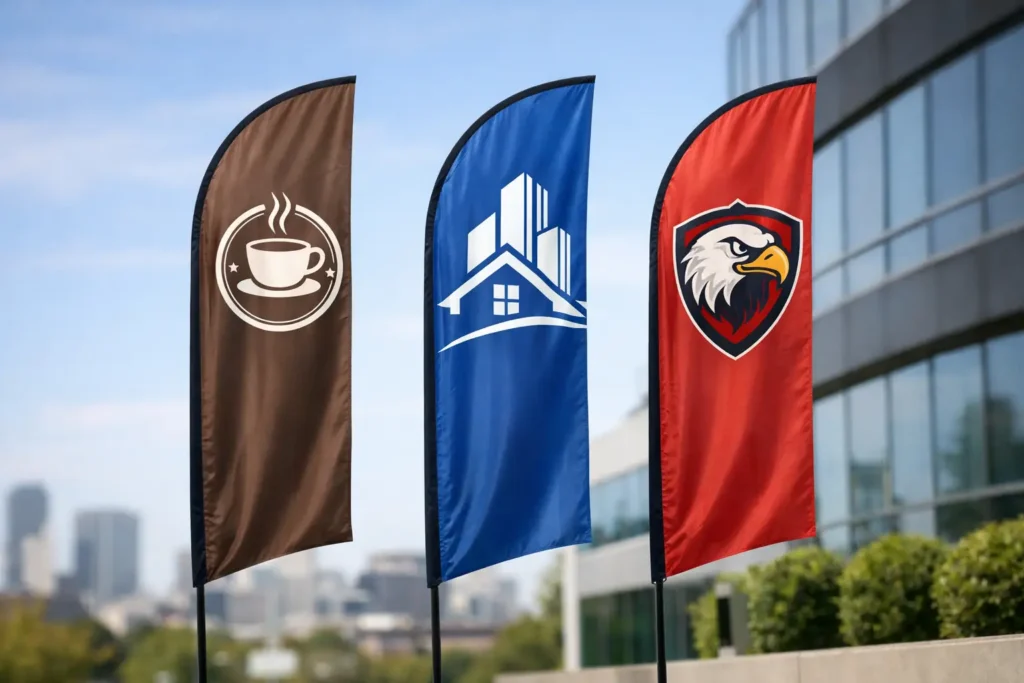
A sign above the door can tell people where you are. Custom swooper flags for business give them a reason to look before they reach the door. Their tall, curved profile and constant motion make them hard to miss along a busy road, outside a dealership, near an event entrance, or beside a pop-up tent.
For businesses competing for local attention, visibility is not a small detail. It is the difference between a customer pulling in and driving past. A well-designed swooper flag puts a clear message in the line of sight: Grand Opening, Now Hiring, Sale, Food, Check-In, Team Store, or your brand name and logo.
Why Swooper Flags Work for Local Visibility
Swooper flags are vertical promotional flags that curve along one side of the pole, creating a distinctive swept shape. They are often called wind flags, blade flags, or flutter flags. Whatever name you use, the advantage is the same: height, movement, and a large printed area working together in places where flat signs can blend into the background.
Unlike a banner mounted against a wall, a swooper flag responds to the breeze. That movement naturally pulls attention toward your message without relying on flashing lights or a complicated display. Even on calmer days, the tall shape creates a strong visual marker that helps customers locate your business, booth, or event area.
They are especially useful when people are making fast decisions. A driver approaching a car wash, a shopper entering a retail center, or an attendee looking for registration has only a few seconds to understand what is in front of them. Your flag should make those seconds count.
Custom Flags are our specialty at Flags Made. That means your display does not have to look like a generic message printed in standard colors. A custom swooper flag can carry your logo, campaign artwork, sponsor branding, event details, or a direct callout built around the promotion you need people to notice now.
Where Custom Swooper Flags for Business Deliver Results
The best placement depends on your location, traffic flow, and message. In most cases, swooper flags perform best when they mark a decision point rather than simply fill empty space. Put them where customers turn, enter, park, line up, or walk toward your display.
Retail stores and restaurants use them near sidewalks, entrances, and parking areas to announce a sale, a new menu item, curbside pickup, or open hours. Auto dealerships can use a coordinated group of flags to identify service lanes, special financing, vehicle categories, and weekend promotions. The height helps organize a large lot without adding permanent signage.
At trade shows and community events, a swooper flag can help visitors find a booth from across the floor or field. It also works well beside a branded canopy, table cover, or outdoor banner, where it adds vertical presence to an otherwise ground-level setup. For schools, booster clubs, and nonprofit fundraisers, flags can spotlight a check-in tent, concession area, auction table, or sponsor zone.
Political and community organizations often need branding that travels easily from one gathering to the next. A custom flag can identify campaign headquarters, a voter registration table, a parade staging area, or a local outreach event. The same idea applies to sports teams, golf tournaments, clubs, and corporate activations: use the flag to make the branded area easy to find.
Design for a Message People Can Read Fast
A swooper flag is not a brochure. Its job is to make a strong impression from a distance, often while the viewer is moving. The most effective designs are clear, high contrast, and built around one primary message.
Start with the question a passerby should answer immediately. Are you open? Are you promoting a limited-time offer? Do you want people to enter, register, donate, or ask about a service? Lead with that message, then support it with your logo or contact information if space allows.
Keep the Main Copy Short
A few large words usually outperform a long sentence. “NOW HIRING,” “OPEN HOUSE,” “FREE ESTIMATES,” and “TEAM PARKING” are easy to understand at a glance. If your logo is already widely recognized, it may be all you need. If your brand is newer, pair the logo with a simple category cue such as “TIRE CENTER,” “COFFEE,” or “DOG GROOMING.”
Vertical layouts need special attention. Text can follow the shape of the flag, but it still needs to read naturally from a distance. Avoid thin typefaces, crowded logos, and low-contrast color combinations. White lettering on a bright yellow field or dark lettering on a light field generally reads better than similar shades placed together.
Build the Flag Around Its Shape
The curved edge is part of the design, not wasted space. A skilled layout uses that motion to guide the eye toward the main copy. A large logo at the top, a short message through the center, and a clean color field can be more effective than trying to fill every inch with information.
If you have finished artwork, a production team can help prepare it for the selected flag size and print area. If you only have a low-resolution logo, an old business card, or a rough idea, that should not stop the project. A full-time graphic design staff can rebuild artwork, clean up a logo, or create an original flag design that fits your branding and your purpose.
Choose the Right Size, Fabric, and Base
There is no single best swooper flag size. A compact flag may be the smarter choice outside a small storefront or on a crowded sidewalk. A taller option has more impact along a roadway, across a sports field, or at a large outdoor event. Before ordering, consider how far away the viewer will be and whether nearby buildings, vehicles, or tents could block the display.
Fabric selection matters because your flag has a practical job to do. Outdoor flags need materials suited to repeated use in changing weather, while an indoor event flag may prioritize a crisp appearance and easy setup. Printing method also affects how color and artwork appear on the finished product. These choices are easier when you can discuss the actual setting, schedule, and artwork with people who make custom flags every day.
The base is equally important. Ground spikes are a natural fit for grass, dirt, and other soft surfaces. Cross bases and weighted options are more useful on pavement, convention floors, and indoor spaces. If the flag will move between locations, choose hardware that fits the surfaces you expect to use most often instead of forcing one base to handle every situation.
Weather is the trade-off buyers should consider honestly. Swooper flags are designed to attract attention in a breeze, but severe wind, storms, and unsafe conditions call for taking the display down. Proper setup, stable hardware, and storing the flag when conditions demand it will help protect your investment.
Make One Flag Part of a Bigger Display
A single custom swooper flag can point customers in the right direction. A set of flags can shape an entire customer experience. Use matching flags at both ends of a parking lot, create an entrance path for a festival, or assign different messages to each area of a dealership or campus.
Consistency matters more than repetition. Your flags, tent, table cover, podium banner, and handout materials should share the same logo treatment, colors, and campaign message. That makes a temporary event space feel organized and credible, even when it is set up for only one afternoon.
It also helps to plan for message changes. A flag with only your logo may be useful year-round. A promotion-specific flag can create urgency for a sale, hiring push, fundraiser, or seasonal event. Many organizations get better long-term value by ordering one branded design for regular use and additional message-driven flags for key campaigns.
A Better Ordering Conversation Starts With the Goal
The fastest way to get the right flag is to begin with what it needs to accomplish. Share where it will be used, the surfaces available for the base, your preferred size range, how many flags you need, and the date you need them. Include your artwork if you have it, but do not worry if the design is not ready.
A quote-driven custom process gives you room to make the right decisions instead of trying to force your project into a rigid template. You can discuss shape, fabric, printing, hardware, quantities, and design support before production begins. That is especially valuable for first-time buyers, multi-location businesses, and event teams coordinating several branded products at once.
Your next customer may only give your location a quick glance. Put a clear, colorful swooper flag where that glance happens, and let your business be the one they remember.