 Skip to content
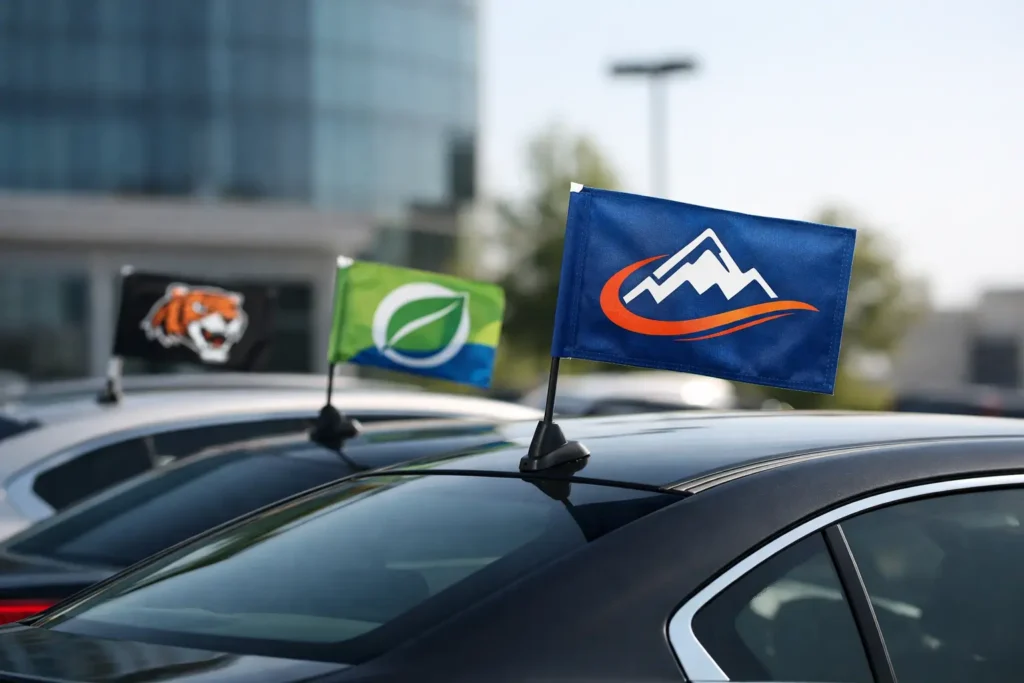
A parked vehicle can disappear into a busy lot. Add custom antenna flags for cars, and it becomes a moving marker for your business, team, fundraiser, dealership, campaign, or special event. The flag sits above the roofline, catches the eye from multiple directions, and keeps your message visible without covering a window or taking up valuable vehicle space.
For organizations that need local visibility, antenna flags are a simple promotional piece with a big job. They can identify event staff, help customers find a dealership promotion, build team spirit on game day, or turn a fleet of everyday vehicles into a coordinated advertising presence. The best results come from matching the flag design, material, and mounting approach to how and where the vehicles will be used.
Why Custom Antenna Flags for Cars Work
Vehicle graphics can be effective, but they are not always practical for a short-term event, a volunteer group, or a promotion that changes throughout the year. Antenna flags offer a flexible alternative. They are easy to spot, easy to distribute, and easy to remove when the event is over.
Their position is part of the advantage. A bright, well-designed flag rises above many cars in a parking area, which makes it useful at parades, tailgates, charity walks, campus events, community festivals, and dealer lots. On the road, the movement of the flag naturally draws attention. A clean logo or short message has more impact than a crowded design trying to say everything at once.
They also make sense when visibility needs to feel personal. A car club can use a shared design while giving members a way to show pride in their own vehicles. A school can provide flags for families before a tournament. A nonprofit can give supporters a recognizable item that travels beyond the fundraising event itself.
Start With the Job the Flag Needs to Do
Before choosing colors or artwork, decide what success looks like. A flag for a one-day parade has different needs than one intended for a dealership promotion or a season of sports events. The answer affects size, print choices, and the amount of detail that will stay readable.
For directional visibility, such as helping guests identify staff vehicles at a large event, a bold symbol and high-contrast colors are usually enough. For brand awareness, use a recognizable logo, business name, or mascot that can be understood at a glance. For a cause, campaign, or fundraiser, a short rallying phrase may work well alongside the organization’s mark.
Distance matters. People will often see an antenna flag from across a parking lot or while passing in traffic. Fine text, small phone numbers, and complicated graphics tend to disappear. Think of the flag as a roadside sign in miniature: one strong visual idea will do more work than a full flyer squeezed into a small space.
Design for Motion, Not a Computer Screen
Artwork can look excellent on a large monitor and still lose its impact once it is printed on a flag that moves in the wind. That is why flag design should begin with simple, high-contrast elements.
A dark logo on a dark background may look polished in a brand guide, but it can become hard to read outdoors. A light-colored logo against a bold field, or a bold logo against a clean white field, generally creates better separation. Strong color choices also help distinguish your vehicles in a crowded setting.
Keep copy short. A company name, event name, web-style handle, school initials, or campaign phrase is often enough. If your organization uses a detailed logo, consider whether a simplified logo mark, mascot, or icon would reproduce more clearly at antenna-flag size.
Flag shape deserves attention as well. A rectangular design provides familiar sign-like space for a logo and message. A tapered or custom-cut shape can add energy and help the flag stand apart, especially for races, sports promotions, or youth events. The trade-off is that an unusual shape may reduce usable room for text. Let the message guide the shape, not the other way around.
At Flags Made, a full-time design staff can rebuild a logo, clean up supplied art, or help create a flag design from the beginning. That support is especially useful for buyers who have a concept but do not have print-ready artwork.
Choose Materials for Real-World Use
Car antenna flags are exposed to sun, movement, weather, and road conditions. Fabric selection and print quality are not minor details when you want a flag that looks good beyond the first outing.
Polyester is a common choice for custom flags because it is lightweight, accepts vivid color, and moves easily in the breeze. Depending on the design and intended use, single-sided or double-sided printing may be the right fit. Single-sided printing can provide strong color and an economical option, with the reverse side appearing as a mirrored image. Double-sided construction is useful when readable artwork is needed from both sides, but it can add cost and weight.
Short-term promotions may call for a straightforward, budget-conscious flag. A business running recurring outdoor events may want to invest more in fabric, finishing, and printing that support repeated use. Be realistic about the environment. A flag used in a calm parking lot is not facing the same wear as one regularly driven at higher speeds or through changing weather.
No fabric flag is permanent. Sun exposure can gradually affect color, and continuous wind adds stress to any material. Good production helps, but proper use and storage also extend the life of the finished product.
Fit and Safety Come First
Not every vehicle has a traditional exterior antenna, and some newer vehicles use integrated or shark-fin antennas instead. Before ordering, confirm how the flag will attach to the intended vehicle or vehicles. A secure mount is essential for both appearance and safe use.
A flag should be positioned so it does not interfere with the driver’s view, vehicle controls, doors, mirrors, or safe operation. It should also be removed before automated car washes and checked regularly for signs of loosening or wear. Local rules can vary, particularly for flags used while driving, so organizations should confirm applicable vehicle and road regulations before distributing them for on-road use.
For some promotions, vehicles may be stationary most of the time. In that case, antenna flags can be used as lot markers, event displays, or dealership attention-getters with less concern about sustained driving conditions. If the goal is mobile advertising, choose a mounting solution intended for that use and give drivers clear handling instructions.
Make Them Part of a Larger Promotion
Antenna flags are most effective when they support a larger visual plan. A dealership might use matching car flags, feather flags, and branded table covers during a weekend sale. A school booster club might coordinate antenna flags with stick flags in the stands and a banner near the entrance. A nonprofit can pair them with a canopy tent and volunteer signage at a community fundraiser.
Consistency makes the display feel intentional. Use the same logo colors, type treatment, and key message across each item. People do not need to read every word to recognize that the vehicles, tent, flags, and banners belong to the same organization.
Consider quantity early, too. A single antenna flag can identify one vehicle. A group of matching flags can create a visible presence across an event site, parade route, or parking lot. Ordering for a team, club, staff group, or promotion often gives the finished campaign more visual force than treating each car as a separate idea.
Plan Your Order With Confidence
A good custom order starts with a few practical details: how many flags you need, what vehicles will use them, where they will be displayed, and whether you have finished art ready to provide. Share the intended use with your flag manufacturer. It helps the production team recommend a size, shape, fabric, and print approach that suits the job.
If your design includes licensed logos, team marks, or campaign graphics, make sure your organization has permission to reproduce them. Clear, high-quality artwork also gives the printer a better starting point and helps protect the sharpness of your final design.
The right antenna flag does not need to be complicated. Give it a message people can recognize in seconds, build it for the conditions it will face, and let your vehicles do the work of getting your name noticed wherever they go.