 Skip to content
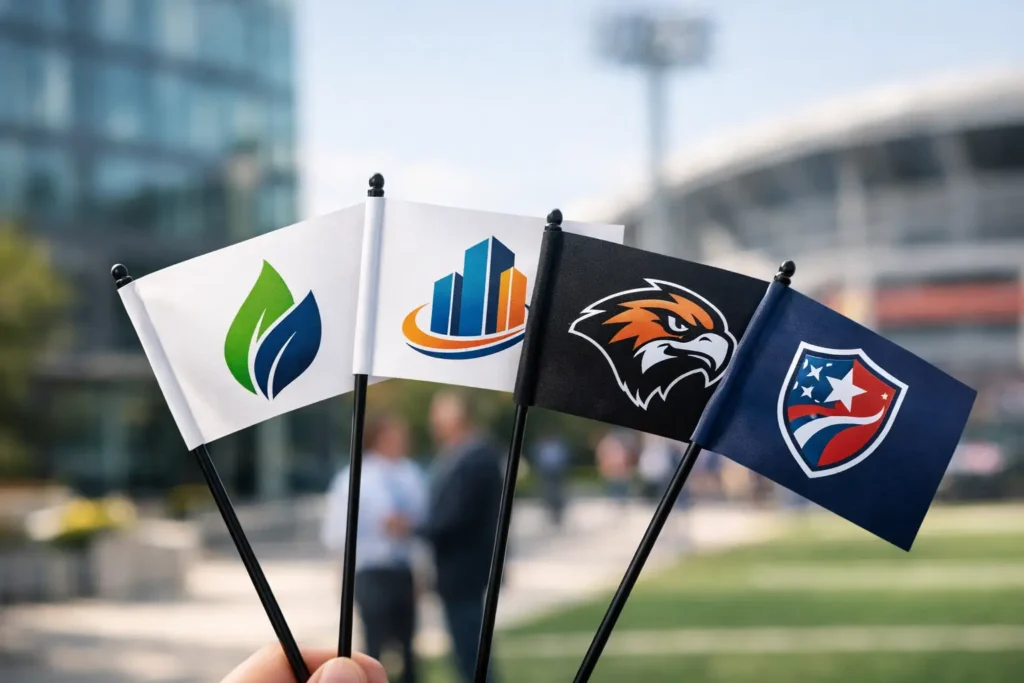
A custom printed stick flag also known as customized hand flags puts your message directly into people’s hands. That matters at a parade, grand opening, fundraiser, school game, dealership promotion, or community event, where attendees can become part of the display instead of simply walking past it. Small in size does not mean small in impact. A crowd waving coordinated flags creates movement, color, and a strong visual moment people remember.
Custom Flags are our specialty, and stick flags are one of the most flexible ways to turn a logo, campaign message, mascot, or celebration design into something easy to distribute. The right choices in size, material, artwork, and finishing will help your flags look sharp in photos, hold up through the event, and represent your organization well.
Why custom printed stick flags work so well
Stick flags or hand flags are built for participation. They can be handed out at a race finish line, placed on tables at a banquet, added to event welcome bags, waved from vehicles during a procession, or used as eye-catching giveaways at a trade show. Unlike a large banner that stays in one location, a handheld flag travels through the crowd.
That mobility is especially useful for organizations trying to build energy around a shared cause or identity. A nonprofit can give supporters flags in campaign colors. A school can create flags featuring its mascot for pep rallies and homecoming. A local business can use branded stick flags at a sidewalk sale or sponsor tent. Political and community groups can use them to give volunteers a clear, unified visual presence.
They also offer an approachable price point for larger quantities. If you need a promotional item that is more visible than a flyer and more event-specific than a standard giveaway, a printed stick flag is a practical fit.
Start with the moment you want to create
Before selecting a flag size or sending artwork, think about how the flag will be used. A flag that is waved at a parade has different needs than one placed in a floral arrangement, displayed on a reception table, or handed to visitors at a booth.
For a short indoor event, lightweight materials and a smaller flag can be exactly right. For an outdoor festival, a slightly larger format may be easier to see from a distance. If flags will be placed along a route or used as a table decoration, consider whether the stick length and display method give the flag enough height to stand out.
Quantity matters, too. A few dozen premium flags can make sense for a sponsor reception, executive event, or golf outing. A high-volume handout for a stadium entrance or parade calls for a design that stays clear and recognizable when viewed quickly. There is no one best configuration. The best choice depends on where the flags will go, who will hold them, and how long they need to perform.
Choosing the right size and shape
The most common stick flag shapes are rectangular, but custom production gives you room to create a format that fits the design. A traditional rectangle works well for logos, simple slogans, flags with stripes, and campaign artwork. It is familiar, efficient, and easy for people to wave.
A custom shape can be a stronger choice when your design depends on a distinctive silhouette. A sports organization may want a pennant-inspired shape. A celebration may call for a curved or specialty cut. A product launch can use a shape that reflects the product or logo itself. The trade-off is that unusual shapes require artwork planned specifically for the cut line, so tiny details near the edges may need adjustment.
Size should follow visibility and handling. Smaller flags are easy to carry, place in centerpieces, or distribute in high quantity. Larger flags provide more room for artwork and are easier to spot in photos or from across a crowd. If your design includes a website, event date, or several sponsor names, do not force all of that information into a small flag. A strong logo and a few readable words will usually do more for visibility.
Keep the message readable at a glance
Stick flags move. They fold, flutter, turn away from the viewer, and may be seen from 20 feet away rather than at arm’s length. This is why bold artwork beats crowded artwork.
Use a clear focal point, such as a logo, mascot, candidate name, event name, or short callout. Choose high-contrast colors so the design stays visible under bright sun, indoor lighting, or camera flashes. Fine lines, small type, and low-contrast color combinations can disappear once the fabric is in motion.
If your organization has detailed brand standards, that does not mean every element belongs on the flag. Your full logo may include a tagline, location, and several colors, but a simplified version can be more effective on a handheld format. A full-time graphic design team can rebuild a logo, clean up supplied artwork, or create a flag layout from an initial idea when needed.
Fabric and printing choices affect the finished look
Fabric choice shapes how a custom flag feels, moves, and displays color. A lightweight fabric is a natural option for flags intended to wave easily and distribute comfortably. Other materials may be chosen for a different texture, opacity, or level of durability. The right fit depends on your event conditions and expected use.
Printing method also deserves attention. Full-color printing is ideal when your artwork includes gradients, photographs, multiple colors, or detailed illustrations. Simple one-color or two-color designs can have a clean, classic promotional look, particularly for school spirit, civic groups, and straightforward logo displays.
Ask early whether your artwork is one-sided or intended to be seen from both sides. Many fabric flags show a reverse image on the back when printed on one side. That is often perfectly acceptable for a waving giveaway, but it may not be the right choice if text must read correctly from both directions. Double-sided construction can solve that issue, though it may add weight and affect cost. This is a useful conversation to have before production begins, not after the artwork is approved.
Do not overlook the stick and finishing
The flag itself gets the attention, but the stick and finishing determine how easily the product is used. A secure attachment helps the flag stay in place during active waving. Smooth, dependable sticks make a better experience for guests, volunteers, students, and customers receiving the flags.
Consider distribution as part of the finishing decision. Will the flags be passed out one at a time at an entrance? Added to gift bags? Set on tables? Packed for a multi-location campaign? The answer can influence size, packing, and the most sensible production approach.
For events involving young children, school groups, or high-energy crowds, discuss intended use with your flag manufacturer. A knowledgeable team can help match the format to the audience and event setting rather than treating every flag order as identical.
Artwork preparation does not need to slow down your project
Some customers come to the Flag Makers with production-ready vector artwork and exact brand colors. Others have a low-resolution logo, a photo of an old flag, a rough sketch, or simply a concept. Both starting points are workable.
The key is to share what you have as early as possible. Include your logo files, preferred colors, any required wording, the event date, and examples of how you expect the flags to be used. If color matching is critical, say so at the beginning. If you are trying to coordinate with a canopy tent, table cover, banner, or car flag, provide those design details so the complete display feels consistent.
Good flag artwork is not just a logo dropped onto a rectangle. It accounts for the flag’s proportions, movement, print area, and viewing distance. A design review can catch a too-small phone number, an off-center layout, or a color combination that will not pop before the order reaches production.
Make stick flags part of a bigger display plan
Custom printed stick flags create their strongest effect when they support the rest of your event branding. Pair them with a branded tent at an outdoor activation, a table cover at a registration area, a podium banner at a speaking event, or larger custom flags that establish visibility from a distance.
The larger pieces attract attention. Stick flags give attendees something to hold, wave, photograph, and take home. That combination can turn a standard event setup into a more active brand experience.
When you request a quote, bring the whole plan to the conversation: your audience, location, event date, quantity, artwork, and the result you want people to see. A well-designed stick flag may be small, but in the right hands, it can make your message impossible to miss.